Roofing
Multi-city, seasonal, heavily contested.
Coastal Craft RoofingOwner-led · Edmonton
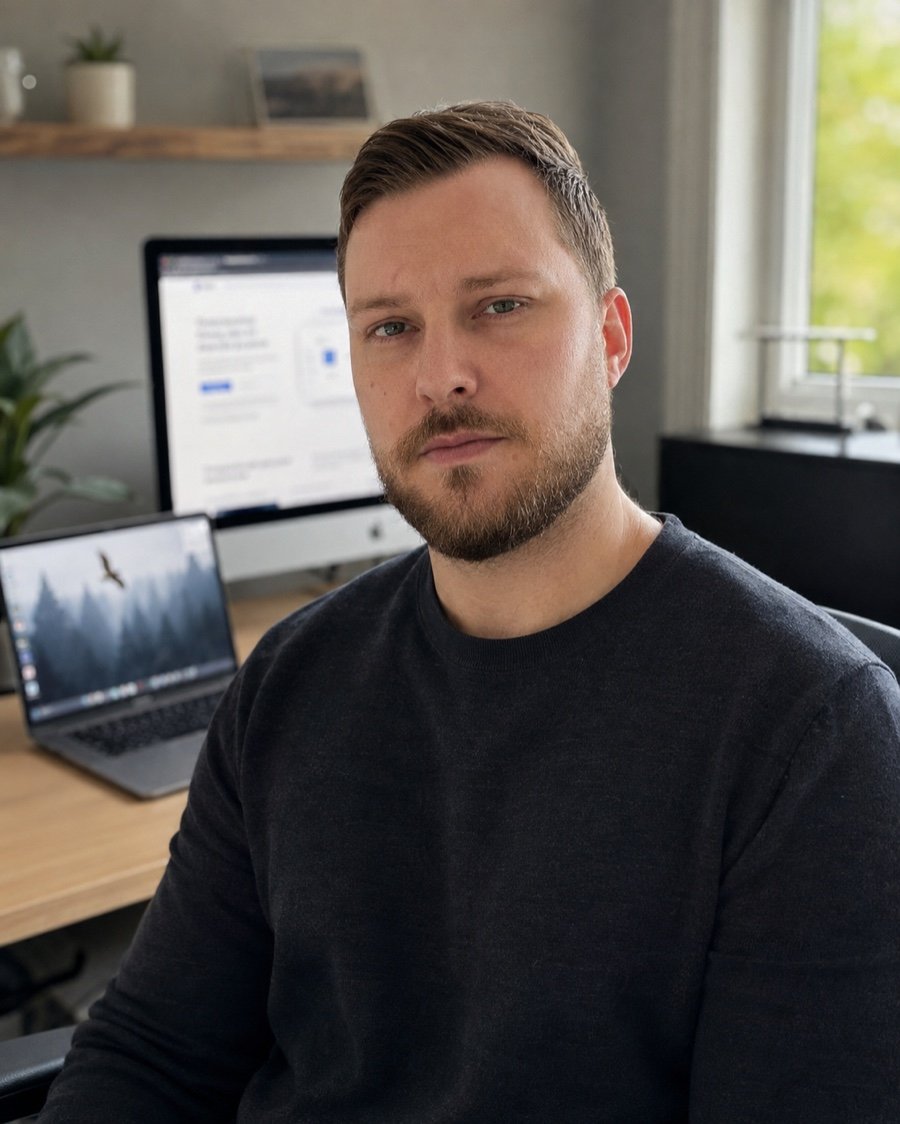
I’m Chris McCormack, owner and SEO lead at YEG Web Solutions. I set the strategy for every engagement and I stay on the account, so when you ask what changed last month and why it mattered, you are asking the person who decided it.
In most agencies the person who wins the account, the person who writes the plan and the people who execute it are three different groups, and the reasoning gets thinner at every handoff. That is the part I built out of this business: there are no handoffs, because there is no one to hand it to. I do the work myself, so the person who wins your account, writes the plan and executes it is the same person, start to finish.
The actual job
Not values. Those belong on the pricing and work pages, where you can check them against something. This is the work itself.
Source code, sitemap, robots directives, schema, indexation state. Most of the expensive problems we find are structural and invisible from the front end: a page switched off, two domains competing, a render path nothing gets past.
Keyword Planner exports, geo-filtered to the markets a business really serves, clustered into a page map. Volume is easy to quote and easy to misread; what matters is which terms a business can realistically win and what a customer from them is worth.
Custom-coded, no page builders or off-the-shelf themes. Because we host what we build, a technical fix goes live the day it is identified instead of joining somebody else's development queue.
Every claim handed to a client is marked as verified, a strong signal, or something only their data can settle. It is slower to write, and it is the reason the numbers hold up when somebody checks them.
One team, one foundation
Most of what you can control about your rankings lives on the website itself: the technical foundation, the architecture, the internal linking, the page structure, the content, the speed. Change any of it and the rankings move.
Which is exactly why the usual setup fails. Most businesses pay an SEO provider to improve their rankings while a separate web company built, and still controls, the website. The people accountable for the results can't change the thing that drives most of them, so every fix waits in someone else's development queue, and when growth stalls the two vendors point at each other. In my experience that split is where most SEO budgets quietly leak, and it is the single most common reason the spend doesn't work.
I removed the handoff. The website and the SEO are one job here: web design, development, technical SEO, content, link building, local work and reporting, all done by me personally. Not managed, done. Nothing is outsourced to a contractor you never meet or a queue I don't control. Because I host what I build, a fix ships the day it is found instead of waiting weeks on a third party.
That is also why the website is included rather than invoiced separately: it is not a bonus, it is the foundation the SEO is built on, and I want it in my hands so I can be held to the result. If your current site is already capable, we improve it instead. The point is that one team owns the whole foundation, not that you always get a rebuild.
Why the pricing works this way
You start at $1,500 a month, with the website build included rather than invoiced separately, so the full rate never lands in month one before anything has been proven.
From there the price rises only as the work produces tracked organic leads, in published steps you can read before you sign. No leads, no increase.
It means we carry the risk in the early months, when you have the least evidence that this will work. That is when it should sit with us.
Range
Five industries with almost nothing in common. The research changes completely between them; the discipline underneath does not, and neither does who is accountable for it.
Multi-city, seasonal, heavily contested.
Coastal Craft RoofingHigh-value items, international buyers, a catalogue that changes constantly.
Kim PennerA buying pool small enough to name, won on credibility.
P&M BargingService-area work with emergency-driven demand.
Jackson Heating & CoolingSharp seasonality and a tight local radius.
WBS LandscapingA national COR/SECOR program across eight provincial standards.
SafetyWiseScale works the same way. A one-city service business and a multi-market program need different architectures, content volumes and reporting. The engagement is scoped to the opportunity, and the resourcing follows the scope rather than the other way around.
Start here
Send the site and the markets you serve. You'll get a straight read on the opportunity, the scope it needs, and whether the investment is worth making.